Ongoing scanning with minimal noise. Proactive protection against new threats. Intelligent insights prioritized by business impact.
The risk-based prioritization cut our weekly ticket noise by more than half. Our engineers spend time fixing what actually matters instead of triaging dashboards.
We went from a quarterly scanning cadence to always-on coverage in a single afternoon. New assets get picked up automatically — nothing slips through the cracks.
Our auditors asked for evidence of continuous vulnerability monitoring and remediation history. Vullify's reports gave us everything we needed, formatted out of the box.
The AWS and Azure integrations surfaced forgotten subdomains and a handful of misconfigured services within the first scan. It paid for itself in one week.
The team walked us through setup, integrations, and our first scan results in under an hour. Their support responses have been fast and technically sharp ever since.
Clear risk summaries, a running fix history, and trend lines that fit on one page. Presenting security posture to our board became ten times easier.
Click to read all Vullify customer success stories
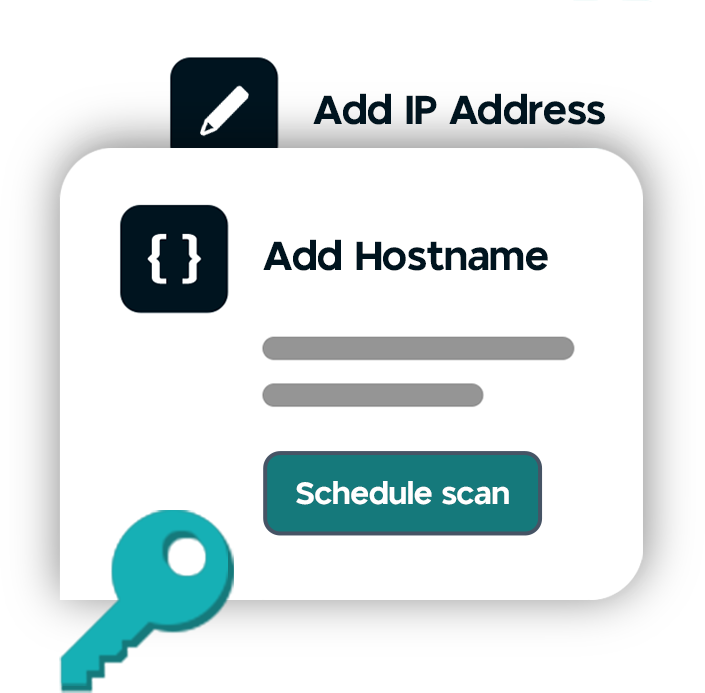
After activating your account, you can begin scanning your system.
Begin scanning just using a domain name or IP address, or set up a cloud integration to automatically retrieve targets.
Access vulnerabilities ranked by severity and identify what's exposed to the internet.
Vullify continuously scans your system for emerging threats, alerting you immediately when new vulnerabilities are detected. Our proactive approach identifies the latest exploits in the wild before automated scanners typically even begin their process, giving you a critical head start.
Vullify cuts through the noise, smartly prioritizing results based on business context. Get actionable remediation guidance, assess your cyber hygiene, and monitor resolution times. Stay informed with real-time alerts via Slack, Teams, and email, so you never miss a critical update on your security posture.
Your network is always evolving, making it a challenge to track what is and isn't exposed to the internet, especially what shouldn't be. With Vullify's external network monitoring, you gain continuous visibility of your perimeter and full control over your attack surface.

Get the latest on the OpenSSH regreSSHion vulnerability (CVE-2024-6387). Vullify security team explain what it is, its potential impact and what action you need to take.

Live from the Vullify vulnerability database
Below are common questions about vulnerability management along with some answers and useful tips
Vulnerability management is the continuous process of identifying, assessing, prioritizing, and remediating security vulnerabilities in your IT infrastructure. It involves scanning your systems, analyzing findings, determining risk levels, and systematically addressing vulnerabilities to reduce your overall security risk.
Vullify uses multiple factors to prioritize vulnerabilities, including CVSS scores, EPSS (Exploit Prediction Scoring System) data, asset criticality, exposure level, and business context. This helps you focus on the vulnerabilities that pose the greatest risk to your organization and ensures efficient use of remediation resources.
Vulnerability scanning is the technical process of detecting vulnerabilities in your systems. Vulnerability management is the broader strategic process that includes scanning, but also encompasses risk assessment, prioritization, remediation workflows, tracking, reporting, and continuous improvement of your security posture.
Continuous vulnerability management involves automatically scanning your systems on a regular schedule, immediately detecting new vulnerabilities as they appear, and providing real-time alerts. This approach ensures that your security posture is always up to date and that new threats are identified and addressed quickly, rather than waiting for periodic manual assessments.
Vullify provides comprehensive tracking and reporting tools that show remediation progress across your organization. You can view metrics like mean time to remediation (MTTR), vulnerability age, remediation rates by team, and track individual vulnerabilities through their lifecycle from discovery to resolution.
Yes, Vullify helps meet compliance requirements for standards like SOC 2, ISO 27001, PCI DSS, HIPAA, and GDPR by providing continuous vulnerability assessments, detailed audit trails, automated reporting, and evidence of your security testing activities. The platform can also integrate with compliance tools like Drata and Vanta.
An effective vulnerability management program includes: defining your risk tolerance and remediation SLAs, establishing clear ownership and workflows, implementing continuous scanning, prioritizing based on risk and business impact, tracking and measuring progress, and continuously improving your processes based on metrics and feedback.
The vulnerability management lifecycle consists of four main phases: Discover (identify all assets and vulnerabilities), Assess (evaluate risk and prioritize), Remediate (fix or mitigate vulnerabilities), and Verify (confirm that remediation was successful). Vullify automates and streamlines each phase of this lifecycle.
Vullify uses advanced techniques including manual verification by security experts, machine learning algorithms, and contextual analysis to reduce false positives. The platform also learns from your remediation actions and feedback to improve accuracy over time.